

2NDNATURE has been awarded U.S. Patent No. 12,573,143 for the spatial analysis methodology at the heart of Rainsteward, our stormwater information management platform. The patent protects the multi-benefit scoring framework that makes portfolio-wide stormwater prioritization for property managers possible — consistently, scientifically, and for the first time at national scale.
If you manage dozens or hundreds of properties, you know the challenge: every site is different, every municipality has its own rules, and comparing stormwater opportunities across locations has meant months of consultants, spreadsheets, and guesswork. This patent validates a better approach. One that builds on 2NDNATURE’s existing portfolio of patented stormwater science and more than a decade of peer-reviewed research published in journals including Nature Scientific Reports, Water Research, and the Journal of Environmental Management.
A Smarter Way to Prioritize
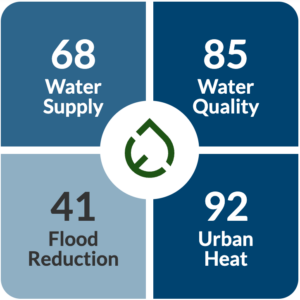
Rainsteward evaluates every property in a portfolio across four critical benefit categories:
- Water Quality — How much urban pollution can be reduced, based on expected pollutant loads, proximity to impaired waterways, and industrial contamination risk.
- Water Supply — The opportunity to capture and infiltrate stormwater to recharge groundwater or support reuse, factoring in drought frequency and soil conditions.
- Flood Reduction — The potential to reduce peak stormwater flows, with attention to flood-prone areas and projected increases in extreme precipitation.
- Urban Heat — Where green infrastructure investments can lower temperatures in the most socially vulnerable communities that need it most.
Each category produces a score from 0 to 100. Combined, these scores form a property’s multi-benefit badge — an intuitive snapshot of relative environmental opportunity that makes portfolio-wide comparison possible at a glance.
Built on Science, Designed for Decisions
What makes this approach patent-worthy isn’t just the scoring — it’s the rigor behind it. Developed in collaboration with The Nature Conservancy’s Brightstorm Program, the methodology draws on publicly available national datasets, 2NDNATURE’s proprietary stormwater modeling, and consistent geospatial analyses. Results are defensible, repeatable, and comparable across the entire country — whether you’re evaluating a warehouse in Phoenix or an office campus in Charlotte.
But the real power is in the hands of the user. Sustainability officers and facilities teams can weight each benefit category to match organizational priorities, filter by property characteristics and stormwater runoff potential, and flag properties in environmental justice communities to align investments with social equity goals. The result is a customized, ranked list of properties ready for action — backed by science, not guesswork.
Turning Resiliency into Revenue Recovery
Environmental impact is only part of the equation. Thousands of municipalities assess stormwater utility fees based on a property’s impervious surface area — parking lots, rooftops, and other hard surfaces that generate runoff. For organizations managing large portfolios, these fees add up to a significant and often overlooked operating expense.
Here’s where it gets interesting: many of those same municipalities offer stormwater fee credits to property owners who implement qualified management practices. Rain gardens, permeable pavement, and detention basins can reduce the fees a property owes — sometimes by 50% or more.
Rainsteward identifies these opportunities across an entire portfolio by analyzing each property’s impervious footprint, local fee structures, and the potential impact of stormwater treatment projects. Instead of treating stormwater fees as a fixed cost of doing business, organizations can strategically reduce them — while simultaneously advancing their environmental goals. It’s the kind of win-win that turns a sustainability initiative into a business case the CFO can get behind.
Why This Matters Now
ESG disclosure requirements are tightening. Investor expectations are growing. Water stress is intensifying across much of the country. Organizations are being asked to do more than set goals — they need to show measurable progress, justify capital allocation, and demonstrate that their sustainability investments are grounded in defensible methodology.
“We built Rainsteward because we saw too many organizations with ambitious water goals and no practical way to incorporate stormwater into their strategies. Corporations potentially manage billions of gallons of stormwater and yet lack a method to prioritize opportunities across a national portfolio. This patent validates that there’s a better approach — one rooted in consistent science and designed for the people who actually have to make capital decisions.”
— Nicole Beck PhD, CEO & Founder, 2NDNATURE
No more spreadsheets. No more gut instinct. Just clear, science-backed priorities — with a financial return to match.
Want to see how your property scores?
Submit a property address and we’ll send you a free Property Profile. You will get your multi-benefit scores, volume of stormwater managed, estimated stormwater fees, and cost recovery opportunities. No site visit required.
Want the full picture? Download our guide: Rainwater as a Corporate Resource